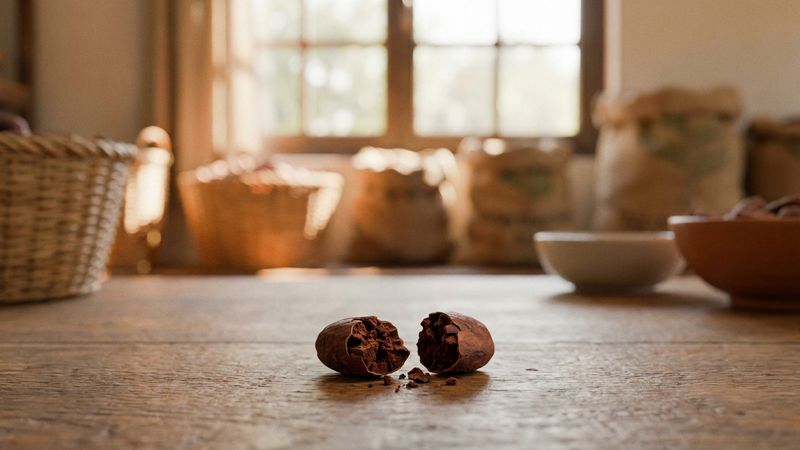
But before a premium bar reaches the shelf, a different question takes shape upstream: what makes the cacao worth preserving in the first place?
The Village Where Cacao Competes With Palm Oil
In Pejalin Village, Bulungan Regency, North Kalimantan, that question is not abstract. Oil palm plantations cover around 5,000 hectares of surrounding land. Cacao occupies just 1,000 hectares. The economics have long favoured conversion: farmers sold raw cacao beans to outside buyers at low prices, losing both income and incentive to maintain their farms.
Yet cacao plays a role that palm oil cannot. The trees help protect local water springs and the wider landscape that supports the village. The problem was that this environmental value had no economic expression.
Mardiatin (Ibu Yen)
At that time, cacao existed in the village, but it was mostly taken by outsiders at low prices. The farmers were losing their spirit. We thought, if we could process it right here in the village, the value would be entirely different.
Processing as Resistance
In late 2023, Pejalin received support through Indonesia's Ecological-Based District Budget Transfer (TAKE) programme. By 2024, a women-led group called KUBE Kita Merong had received cacao-processing equipment and begun learning the craft from scratch: selecting beans, fermenting, roasting, tempering.
Today, the group's nine members (five active in daily production) process around 300 kilograms of dried cacao beans each month under the brand Kayan Koa. They produce chocolate bars, cocoa butter, cocoa powder, and ready-to-brew cocoa products, handling cacao entirely from upstream to downstream.
Ibu Yen
What differentiates us is that we process all the cacao ourselves until it is finished, not just the chocolate bars. The powder and the butter are also from here in Bulungan, so the taste is consistently authentic.
The decision to process locally is also a decision to resist land conversion.
Ibu Yen
If cacao had value and the farmers could live off it, they wouldn't easily abandon their farms. This is also about protecting our water and soil.
The Fermentation Problem
Quality control remains the hardest part.
Many farmers still sell unfermented beans because fermentation takes time, delaying income they need immediately. But unfermented cacao produces inconsistent, often harsh flavours.
Ibu Yen
Разликата между посредствеността и съвършенството се крие в търпението на ферментацията.
We do not dare take unfermented cacao because it greatly affects the taste and quality. Therefore, we must also provide education and insights to farmers so that the processing is correct.
The group works with technical partners including Indonesia's National Research and Innovation Agency (BRIN) and researchers from Universitas Kaltara, who are exploring innovations like white chocolate and cacao-husk tea to build a more resilient village-based value chain.
What the Numbers Show
Kayan Koa buys beans from Pejalin farmers at stable prices of 80,000 to 90,000 Indonesian rupiah per kilogram (roughly €4.50 to €5). Monthly turnover has grown from around three million rupiah in the early days to approximately 16 million rupiah (around €900) today. The business has created work for other women and young people, especially during peak production.
Ibu Yen
Women in the village now have a role, an income, and are involved in development. My hope is that our production house could soon be fully established, and that we could deepen our processing training so the quality would remain consistent.
Civil society organisation Pilar Nusantara Association (PINUS) has helped amplify the story through digital platforms and national forums, positioning Kayan Koa within a broader restorative economy movement.
What Craft Preserves
Pejalin offers a reminder that what makes chocolate truly premium begins long before the wrapper. It begins in decisions made by women in villages, in the choice to process locally rather than sell raw, in the protection of water sources that would otherwise be lost to industrial agriculture.
The question for anyone who buys craft chocolate, or makes it, or sells it: what are you choosing to preserve by choosing to make things well?
Frequently Asked Questions
Q: What is the TAKE programme that supported Pejalin Village?
A: TAKE stands for Ecological-Based District Budget Transfer, an Indonesian government programme that provides funding for green economic development in villages. Pejalin received support through TAKE in late 2023, which enabled the purchase of cacao-processing equipment in 2024.
Q: How much cacao does KUBE Kita Merong process each month?
A: The women's collective processes approximately 300 kilograms of dried cacao beans per month, producing chocolate bars, cocoa butter, cocoa powder, and ready-to-brew cocoa products under the Kayan Koa brand.
Q: Why does fermentation matter for cacao quality?
A: Fermentation develops the flavour compounds that give chocolate its complexity. Unfermented cacao produces inconsistent, often harsh flavours. KUBE Kita Merong refuses to buy unfermented beans and instead educates local farmers on proper fermentation techniques to maintain quality standards.
The Slowmade Letter: what happened in the city this week, gathered into one letter.
By subscribing you agree to receive the Slowmade Letter once a week at this address. You can unsubscribe with one click, at any time. How we handle your data
Analytics cookies
We use Google Analytics and Microsoft Clarity to understand which stories get read and how you move around the site. Nothing is recorded without your consent. The cookies needed to sign in always work. Learn more