Reading the Land: What Coffee Origin Actually Means

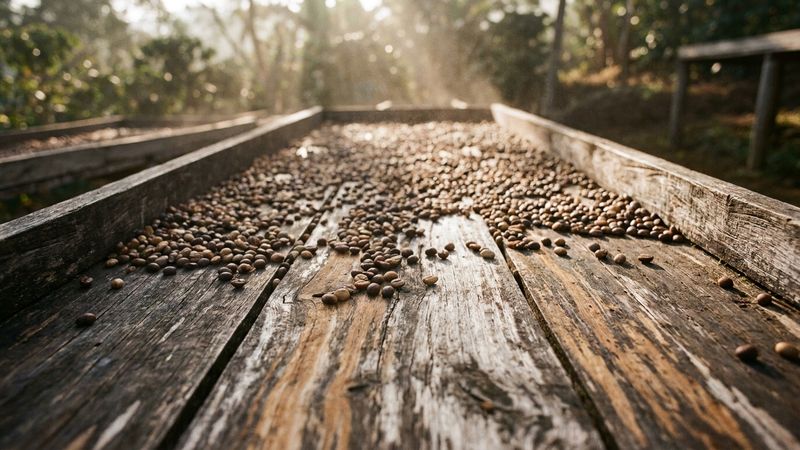
Fermented cherry pulp, thick and sweet, clings to the air at a washing station in Huila, Colombia. Hands sort through raised beds of drying parchment at dawn. Water runs through channels, separating density, separating quality. These are not romantic images from a coffee bag. They are the daily mechanics of origin, the labour that determines whether a bean arrives in Sofia with complexity or without.
Sofia's specialty coffee culture has grown precisely because roasters and cafes here refuse to accept anonymity. At over 65 specialty cafes across Bulgaria, the question "where does this come from?" is no longer unusual. It is expected. The Bulgarian palate, shaped by generations of wine and tea traditions, already understands terroir. The idea that soil, altitude, and microclimate encode themselves into flavour is not exotic here. It is familiar logic applied to a different crop.
The Farm as Archive
A coffee farm is not just a place where beans grow. It is a living record of environmental conditions, written into every seed.
Altitude shapes acidity and sweetness. Coffees grown above 1,500 metres experience cooler temperatures that slow cherry maturation, allowing sugars and organic acids to develop more fully. Research suggests sucrose content increases by roughly 10% for every 300 metres of elevation gain. This is why Ethiopian Sidamo, grown at elevations exceeding 1,500 metres, often presents floral brightness and citrus notes, while lower-altitude Brazilian coffees tend toward smooth, nutty profiles.
Soil composition matters just as much. Volcanic soils in East Africa and Central America, rich in minerals like potassium and phosphorus, produce coffees with bright acidity and complex flavour structures. Clay-heavy soils contribute body and earthy undertones. The same Bourbon variety planted in Rwanda's volcanic highlands will taste markedly different from Bourbon grown in Colombia's loamy valleys.
Climate completes the picture. Rainfall patterns, temperature swings between day and night, humidity levels during drying: each variable leaves its mark. A farm in Nariño, Colombia, sitting at 2,000 metres with warm days and cool nights, produces coffees with layered sweetness and vibrant acidity that command premium prices at auction.
The People Behind the Data
Here is where origin stories often go wrong. They romanticise the landscape while erasing the labour.
Traceability only works if someone on the farm side is willing to document and share data. This is not poetry. It is agronomy, record-keeping, and expertise. The EU Deforestation Regulation (EUDR), which requires GPS coordinates for every plot of land producing coffee sold in Europe, has made this explicit. No coordinates, no compliant documentation, no market access.
For the roughly 80% of the world's coffee produced by smallholder farmers, this represents a structural challenge. Many farm plots have never been formally mapped. The thread connecting cherry to specific land often snaps somewhere between harvest and wet mill. Exporters who once delivered clean paperwork now discover their traceability chains have a gap at the very beginning.
The farmers and agronomists who maintain this knowledge, who record harvest dates and processing methods, who walk GPS devices around plot boundaries, are performing skilled work. Specialty coffee's origin obsession depends entirely on their willingness to participate.
The Roaster as Translator
Between the farm and your cup sits the roaster, whose job is to understand origin deeply enough to communicate it honestly.
Specialty roasters across the region, including operations like Arusha Roastery in Maramureș, Romania, are part of a growing network that prioritises direct sourcing and transparent origin documentation.
With over a decade of experience and national and international awards, Arusha represents the kind of roaster that invests in knowing exactly where their beans come from, roasting in small batches to preserve what is distinctive in each coffee.
This is not marketing. It is a choice about quality and accountability. Roasters who build direct relationships with farms can adjust roast profiles based on specific lot characteristics. They can tell you not just the country, but the municipality, the altitude, the processing method. They can explain why this particular washed Colombian tastes different from last season's natural Ethiopian.
In Sofia, roasters like DABOV Specialty Coffee have built their reputation on exactly this kind of transparency. As a Cup of Excellence judge, founder Jordan Dabov regularly secures lots with full traceability, offering guests one of the country's largest selections of documented single origins.
The Informed Choice
Choosing to buy traceable coffee is not about guilt. It is about participating in a system that values documentation, fairness, and environmental stewardship.
Research on coffee supply chain sustainability increasingly emphasises that transparency and traceability are not optional extras. They are structural requirements for addressing farmer poverty, environmental degradation, and quality consistency. When you know where your coffee comes from, you can make decisions that support the people and practices you want to see continue.
The next time you order a single origin at a Sofia cafe, or buy a bag with a farm name printed on the label, consider what that information represents. Someone walked a GPS device around a plot boundary. Someone recorded the processing method. Someone decided that documentation was worth the effort.
What does it mean to taste a place you have never been? Perhaps it means acknowledging that every cup carries the work of hands you will never meet, in soil you will never touch, under weather you will never feel. The responsibility that comes with that knowledge is not a burden. It is a connection.
Frequently Asked Questions
Q: What is coffee terroir and why does it affect flavour?
A: Terroir refers to the combination of environmental factors, including altitude, soil composition, climate, and rainfall, that influence how coffee develops. Higher altitudes produce denser beans with more complex acidity, while volcanic soils contribute bright, mineral-driven flavours. These variables are encoded into the bean before roasting ever begins.
Q: What does the EU Deforestation Regulation (EUDR) require for coffee traceability?
A: The EUDR requires that coffee sold in the EU be accompanied by GPS coordinates for the specific plot of land where it was grown, verified against satellite deforestation datasets. This regulation, with requirements binding from late 2025 for large companies, means exporters must document farm-level origin data, not just mill or cooperative information.
Q: How can consumers verify that coffee origin claims are accurate?
A: Look for specific details beyond country of origin: farm or cooperative name, altitude, processing method, and harvest date. Roasters who invest in direct trade relationships can typically provide lot-level documentation. Certifications like Cup of Excellence indicate coffees that have been cupped and verified by international judges, adding another layer of traceability.
The Barista